Quick Answer
Zip does not appear to routinely report standard on-time payments as positive credit history. However, Zip’s current agreement states that loans made through the Zip app and Zip Checkout are originated by WebBank, and the WebBank Loan Agreement says Zip and/or WebBank may report information about your loan account to credit bureaus. It specifically warns that late payments, missed payments, or other defaults may be reflected on your credit report.
This does not mean every late payment will automatically be reported. Zip’s agreement uses the word “may,” and it does not provide a universal rule stating that a payment will be reported after 30, 60, or 90 days.
Source checked: Zip Anywhere and Zip Checkout Customer Agreement and WebBank Loan Agreement, last updated June 2026.
What Zip’s Current Loan Agreement Actually Says
Zip’s current terms provide more detail about credit reporting than a simple yes-or-no answer might suggest.
Loans made through the Zip app and Zip Checkout are originated by WebBank, a Utah-chartered industrial bank. Under the WebBank Loan Agreement, Zip and WebBank are authorized to obtain consumer reports in connection with a loan, including for servicing, account administration, collection and consideration for other credit products.
More importantly, the agreement specifically addresses what can happen after the loan is opened. It states that Zip and/or WebBank may report information about the loan account to credit bureaus and that late payments, missed payments or other defaults may be reflected on the borrower’s credit report.
The agreement also defines failure to make a required payment by its due date as an event of default. Following a default, WebBank may take collection actions permitted by law, including disclosing information about the borrower and the account to one or more consumer reporting agencies. Zip Customer Agreement and WebBank Loan Agreement.
There is an important distinction here: the agreement says Zip and WebBank “may” report this information. It does not say that every Zip loan is reported or that every late payment will automatically appear on a credit report.
That is why it would be inaccurate to say either that Zip never reports to credit bureaus or that every missed Zip payment will be reported.
Does Zip Report to Experian, Equifax and TransUnion?
Zip’s current loan agreement does not specifically state that every Zip loan is routinely reported to Experian, Equifax and TransUnion.
Instead, the agreement uses broader terms such as “credit bureaus,” “consumer reporting agencies” and “one or more consumer reporting agencies.” It gives Zip and WebBank the ability to report loan information, including potentially negative information involving late payments, missed payments and defaults.
The agreement does not identify a routine furnishing schedule for each of the three major credit bureaus, nor does it promise that information about every Zip loan will appear with all three.
So, based on the current agreement, the most accurate answer is: Zip and WebBank reserve the right to report loan information to consumer reporting agencies, but the agreement does not establish that every Zip account is routinely reported to Experian, Equifax and TransUnion.
If you are trying to determine whether a specific Zip loan has been reported, the most reliable way to know is to review your credit reports individually, since information appearing with one credit bureau does not necessarily appear with the others.
Does Zip Show Up on Your Credit Report?
Zip may not necessarily appear on your credit report as a traditional positive tradeline during normal use. However, that does not mean information related to a Zip loan can never appear on your credit report.
Zip’s current WebBank Loan Agreement allows Zip and WebBank to report information about a loan account to credit bureaus. The agreement specifically states that late payments, missed payments or other defaults may be reflected on a credit report.
If you are checking your credit report for a Zip loan, look beyond the company name “Zip.” Depending on what has been reported and how the credit bureau displays the information, relevant information could potentially appear in:
- Your accounts or tradelines
- Negative or adverse account information
- Collection accounts
- Credit inquiries
- An entry associated with WebBank
WebBank is important because loans made through the Zip app and Zip Checkout are originated by WebBank. However, seeing WebBank on your credit report does not automatically mean the account is connected to Zip.
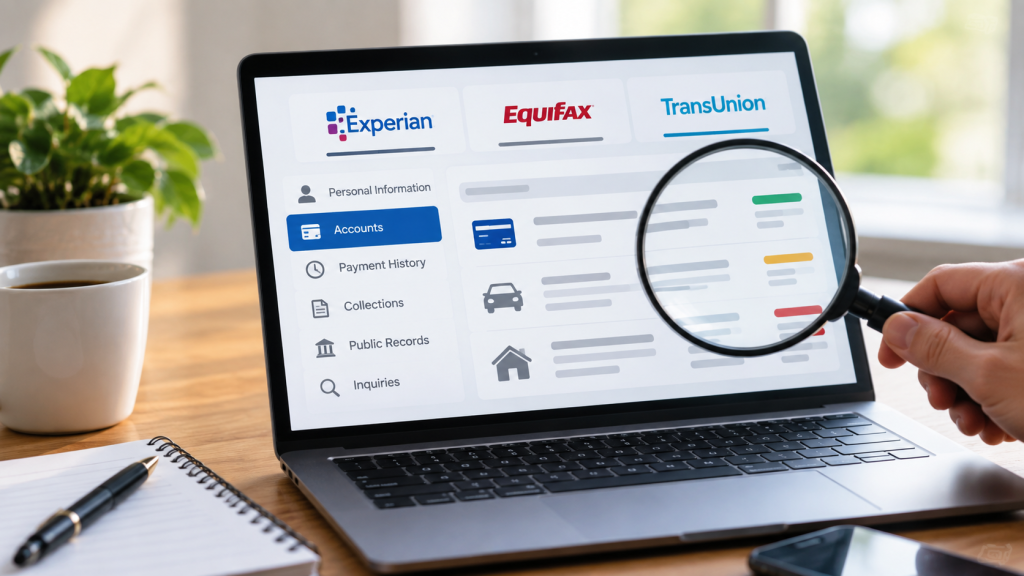
If you are unsure what you are looking at, our How to Read a Credit Report guide explains how to review tradelines, payment history, collections, inquiries and other sections of your credit reports.
Does Zip Report On-Time Payments?
Zip’s loan agreement gives Zip and WebBank the ability to report loan information to credit bureaus, but it does not state that they routinely report on-time Zip payments as positive payment history.
This distinction matters if you are using Zip with the expectation that making your payments on time will establish credit history or increase your credit score. The agreement permitting credit reporting does not necessarily mean that every successful payment is furnished to the credit bureaus.
In other words, you should not assume that simply using Zip and paying each installment on time will add positive payment history to your Experian, Equifax or TransUnion credit reports.
Does Zip Help Build Credit?
You should not rely on standard Zip use as a credit-building strategy unless the specific Zip product you are using explicitly states that positive payment activity is reported to the credit bureaus.
Making your Zip payments on time is still important. Zip’s agreement states that late payments, missed payments and other defaults may be reflected on your credit report. That creates an important difference: the possibility of negative information being reported does not mean your normal on-time payments are routinely being reported as positive credit history.
Does Zip Report Late or Missed Payments?
Yes, late or missed Zip payments can potentially be reported to the credit bureaus.
Zip’s WebBank Loan Agreement specifically states that “late payments, missed payments, or other defaults on your account may be reflected in your credit report.” The agreement also allows WebBank and/or Zip to report information about a loan account to credit bureaus.
The word “may” is important. The agreement does not say that every late payment will automatically be reported.
Under the agreement, if a scheduled payment is not received in full by its payment due date, the borrower can be considered in default. Subject to applicable law and any right to cure, WebBank can then exercise available remedies, including disclosing information about the borrower and their payment history to one or more consumer reporting agencies.
However, the agreement does not provide a fixed timeline for when that reporting occurs. It does not say, for example, that every payment one day late, 30 days late or 60 days late will automatically be reported.
The safest takeaway is simple: a missed Zip payment can potentially reach your credit report, but Zip does not promise that every missed payment will be reported on a specific schedule.
How Late Can You Be Before Zip Reports You?
Zip does not publish a universal 30-, 60- or 90-day credit-reporting threshold in its current WebBank Loan Agreement.
This is an important distinction because being late under your loan agreement and having a late payment reported to a credit bureau are not necessarily the same event.
Under the agreement, WebBank can consider you in default if it does not receive a required payment by its due date. That establishes your contractual payment status. Separately, the agreement gives WebBank and Zip the ability to report information about the loan to consumer reporting agencies.
In other words:
Payment due date: Determines when your required payment is due.
Default: Under the agreement, failure to make a required payment by its due date can constitute an event of default.
Credit reporting: Zip/WebBank may subsequently report information about the loan, including late payments, missed payments or defaults.
The agreement does not connect those events with a specific number of days.
That means you should not assume that missing one Zip payment automatically creates a negative entry on your credit report. But you also should not assume that an unpaid Zip balance cannot eventually affect your credit simply because it has not appeared yet.
Can a Zip Account Go to Collections?
Yes. Zip’s current agreements allow for collection activity when a borrower fails to repay a loan as required.
The WebBank Loan Agreement gives WebBank several potential remedies following an event of default, subject to applicable law. These can include demanding payment of the amount owed, taking collection action, disclosing information to consumer reporting agencies and taking legal action to recover the balance.
The agreement also specifically references service providers, debt collectors and collection attorneys that may contact borrowers regarding their accounts. It states that reasonable attorney fees, court costs and collection costs may also be charged where permitted by law.
Zip’s broader Customer Agreement additionally allows accounts and contractual rights to be sold, assigned or transferred.
What the agreements do not provide is a universal timeline for when an unpaid Zip loan will be sent or assigned to collections. There is no published rule in the agreement we reviewed stating that an account goes to collections after exactly 30, 60 or 90 days.
So if you have missed a Zip payment, the absence of a collection account on your credit report today does not guarantee that the unpaid balance cannot later result in collection activity or credit reporting.
Why Is WebBank Showing on My Credit Report?
If you see WebBank on your credit report and you have used Zip, the account may be related to Zip financing.
Zip’s current Customer Agreement states that loans made through the Zip app and Zip Checkout are originated by WebBank, while Zip services the loans. This means WebBank is the lender behind these Zip transactions, even though you may have applied, made the purchase and managed your payments through Zip.
However, seeing WebBank on your credit report does not automatically mean the account came from Zip. WebBank originates loans and provides banking services for other financial products and companies as well.
If you do not immediately recognize a WebBank entry, compare the information on your credit report with your Zip account and purchase history. Pay particular attention to:
- The date the account was opened
- Current balance
- Original loan amount
- Creditor or contact information
- Partial account number
- Zip purchases made around the same date
If those details line up with a purchase you financed through Zip, the WebBank entry may be connected to that transaction. If they do not match anything you recognize, investigate the account before assuming it belongs to you.
Does Applying for Zip Affect Your Credit Score?
Zip says that applying for its service involves a soft credit check, rather than a hard credit inquiry. A soft credit check allows Zip to review certain credit information when evaluating an application without the inquiry itself affecting your credit score.
This is different from the credit reporting that can potentially occur after a Zip loan has been made. An application inquiry and the subsequent reporting of loan or payment information are separate events.
Does Zip Use a Hard or Soft Credit Check?
Zip states that it uses a soft credit check when you apply. Soft inquiries do not affect your FICO Score and may appear only in the portion of your credit report visible to you rather than to prospective lenders.
That means applying for Zip should not lower your credit score simply because Zip checked your credit. However, what happens with a Zip loan afterward is a separate issue. As discussed above, Zip’s WebBank Loan Agreement allows certain loan and payment information to potentially be reported to consumer reporting agencies.
What Happens If You Dispute a Zip Charge?
Zip’s current Billing Rights Statement provides specific protections when you believe there is an error on your statement.
Zip instructs consumers to report suspected billing errors in writing or electronically and generally requires the dispute to be submitted within 60 days after the error appeared on the statement. The consumer should identify the account and order, the amount in question, and explain why they believe the charge is incorrect.
While Zip investigates the disputed amount, its Billing Rights Statement says it cannot try to collect that amount or report you as delinquent on that amount. You remain responsible for paying the portions of your balance that are not being disputed.
Zip states that it must generally acknowledge the dispute within 30 days of receiving the letter and either correct the error or explain why it believes the bill is correct within 90 days.
If Zip determines there was an error, you will not have to pay the disputed amount or related interest or fees. If Zip determines the charge was correct, however, it can require payment. If that amount then remains unpaid, Zip states that it may report you as delinquent.
There is another important protection if you still disagree with Zip’s decision. According to its Billing Rights Statement, if you write to Zip within 10 days stating that you still refuse to pay the disputed amount, Zip cannot report you as delinquent without also reporting that you are questioning the bill.
That distinction matters when reviewing your credit report: a legitimately disputed Zip balance should not simply be treated the same way as an undisputed delinquent balance while the billing-error process is underway.
What Should You Do If You Don’t Recognize a Zip or WebBank Account?
If you find a Zip or WebBank account on your credit report that you do not recognize, don’t immediately assume it is fraudulent. Because WebBank originates loans made through the Zip app and Zip Checkout, a WebBank entry could be connected to a Zip purchase you previously made.
Start by checking your Zip account and purchase history. Compare your transactions with the information shown on the credit report, including the account opening date, original loan amount, current balance, partial account number and payment history.
Next, check your credit reports from Experian, Equifax and TransUnion. The account may appear differently—or may not appear at all—across the three bureaus.
If the information appears related to Zip but something is incorrect, contact Zip and investigate the discrepancy. You can also dispute inaccurate information with the credit bureau reporting it and with the company furnishing the information.
If you have no record of the account and believe someone used your identity to obtain the loan, treat the situation as potential identity theft rather than a normal billing dispute.
Zip’s own agreement addresses this situation. It includes procedures for identity-theft victims requesting transaction records under Section 609(e) of the Fair Credit Reporting Act (FCRA). Those records can help an identity-theft victim document transactions allegedly made using their identity.
The important first step is determining whether the account is yours, inaccurate, or potentially fraudulent before deciding how to respond.
How to Check Whether Zip Is on Your Credit Report
If you want to know whether Zip has reported information about your account, review your credit reports rather than relying only on what appears inside the Zip app.
Start with the accounts or tradelines section. Look for an account associated with Zip or WebBank and compare its opening date, balance, original amount and account number with your Zip purchases.
Then review the rest of the report for:
- Negative or adverse accounts: Check for late payments, missed payments, defaults or other negative account information.
- Collections: Look for any collection account that could be associated with an unpaid Zip balance.
- Hard inquiries: Review companies that accessed your credit in connection with an application for credit.
- Soft inquiries: Check the section containing inquiries that generally do not affect your credit score.
- WebBank references: Because WebBank originates loans through the Zip app and Zip Checkout, don’t search only for the word “Zip.”
If you aren’t familiar with these sections, see our How to Read a Credit Report guide for a step-by-step walkthrough of tradelines, payment history, collections and inquiries.
Also remember that credit reports do not necessarily update immediately after an account changes. Our How Often Does Your Credit Score Update? guide explains the difference between when a creditor reports information, when a credit bureau processes it and when a new credit score may be calculated.
Does Zip Affect Your Credit Score?
Zip can potentially affect your credit, but the impact depends on what information is actually added to your credit report.
There are several possible pathways.
An inquiry may occur when you apply for Zip. For Zip’s standard application process, Zip says it uses a soft credit check, which does not affect your FICO Score. If Zip offers other products or processes in the future, however, check the terms for the specific product rather than assuming every Zip product handles credit inquiries identically.
After a loan is opened, Zip’s WebBank Loan Agreement allows loan information to potentially be reported to credit bureaus. That means your credit could potentially be affected if information such as a late payment, missed payment, default or collection account reaches your credit report. Other reported loan information could also be considered depending on the scoring model and how the account is reported.
However, the opposite should not be assumed. Making your normal Zip payments on time does not automatically mean your credit score will increase. Zip’s current agreement permits credit reporting generally, but it does not state that standard on-time payment activity is routinely furnished to the three major credit bureaus as positive credit history.
Ultimately, whether Zip affects your score depends on what information is actually present in your credit file and how the credit-scoring model evaluating that report treats it.
Zip Credit Reporting FAQs
Does Zip report to Experian?
Zip’s current WebBank Loan Agreement says information about a Zip loan may be reported to credit bureaus, but it does not state that every Zip loan is routinely reported to Experian. If you want to know whether a specific Zip account appears with Experian, check your Experian credit report directly.
Does Zip report to Equifax?
Zip’s agreement permits Zip and WebBank to report loan information to consumer reporting agencies, but it does not specifically promise routine reporting of every account to Equifax. An account appearing with one bureau also does not necessarily mean it will appear with the others.
Does Zip report to TransUnion?
Zip’s current agreement does not state that every Zip loan is routinely furnished to TransUnion. However, it does allow loan information to be reported to credit bureaus, including information involving late payments, missed payments or defaults.
Does Zip report late payments?
Zip’s WebBank Loan Agreement specifically states that late payments, missed payments or other defaults may be reflected on your credit report. The word “may” is important because the agreement does not say every late payment will automatically be reported.
Does Zip report on-time payments?
Zip’s agreement permits credit reporting generally, but it does not state that standard on-time Zip payments are routinely reported as positive payment history. You should not assume that every successful Zip payment is being added to your credit reports.
Does Zip help build credit?
You should not rely on standard Zip use as a credit-building strategy unless the specific Zip product you are using explicitly states that positive payment activity is reported to the credit bureaus. Paying on time is still important because Zip’s agreement allows late payments, missed payments and defaults to potentially be reported.
Does Zip use WebBank?
Yes. Zip’s current Customer Agreement states that loans made through the Zip app and Zip Checkout are originated by WebBank, an FDIC-insured, Utah-chartered industrial bank, and serviced by Zip.
Does Quadpay report to credit bureaus?
Quadpay was the former name associated with Zip in the U.S. If you are asking about a current Zip account or loan, the current Zip and WebBank terms are the more relevant documents to review. Those terms allow loan information to potentially be reported to credit bureaus, including late payments, missed payments and defaults.
How long before Zip reports a late payment?
Zip’s current loan agreement does not provide a universal credit-reporting timeline. It does not state that a late payment will automatically be reported after 30, 60 or 90 days. Missing a payment by its due date can constitute a default under the agreement, but credit-bureau reporting is a separate action that may occur.
Can Zip send you to collections?
Zip’s agreements allow collection activity on unpaid accounts, including the use of debt collectors and collection attorneys where applicable. The agreements also allow certain collection costs, account assignment or transfer, legal remedies and disclosure to consumer reporting agencies. However, they do not specify a universal number of days before an unpaid account will be sent to collections.
Does Zip show up as WebBank?
It can potentially be associated with WebBank because WebBank originates loans made through the Zip app and Zip Checkout. However, a WebBank entry should not automatically be assumed to be a Zip account. Compare the account date, balance, original amount, account number and other details with your Zip purchase history.
Can checking Zip hurt your credit score?
Zip says its standard application process uses a soft credit check. Soft inquiries do not affect your FICO Score. This is different from any loan or payment information that may subsequently be reported after using Zip.
What happens if I miss one Zip payment?
A missed payment can put you in default under the terms of the loan agreement and may result in fees or other remedies permitted by the agreement and applicable law. Zip’s agreement also states that late or missed payments may be reflected on your credit report. However, it does not say that missing one payment automatically results in a negative credit-bureau entry.
Can Zip report a disputed amount?
Zip’s Billing Rights Statement says that while it investigates a properly submitted billing error, it cannot try to collect the disputed amount or report you as delinquent on that amount. If Zip determines the bill is correct and the amount remains unpaid, it may subsequently report the delinquency. If you continue to dispute the amount in writing as provided under its billing-error procedure, Zip says it cannot report you as delinquent without also reporting that you are questioning the bill.
The Bottom Line
Zip’s current loan agreement does not support a simple “Zip never reports to the credit bureaus” answer.
Loans through the Zip app and Zip Checkout are originated by WebBank, and the WebBank Loan Agreement allows information about those loans to be reported to credit bureaus. It specifically states that late payments, missed payments and other defaults may be reflected on a credit report.
At the same time, the agreement does not say that every Zip account or every on-time payment is routinely reported. It also does not establish a universal 30-, 60- or 90-day timeline for when a late payment will be reported.
If you see Zip or WebBank on your credit report, verify the account details before assuming the information is either correct or fraudulent. Compare the dates, balances, account information and payment history with your own records and investigate anything that does not match.
See What May Be Affecting Your Credit Score
Want to understand which parts of your credit profile may be helping or hurting your score? Use our free Credit Score Improvement Calculator to identify potential areas for improvement.
Credit Score Improvement Calculator →
Not sure what you’re looking at on your reports? Our How to Read a Credit Report → guide walks you through accounts, balances, payment history, collections, inquiries and other important sections step by step.
Author Profile

- Laura Bennett is a senior writer and credit specialist at Credit Repair Dudes, with deep, hands-on knowledge of how the credit system actually works behind the scenes. She focuses on breaking down complex credit laws, reporting practices, and dispute strategies into clear, practical guidance consumers can use. With years of experience navigating FCRA compliance, bureau reporting, and creditor behavior, Laura’s work is centered on accuracy, transparency, and helping people make informed decisions about their credit.
Latest entries
 Credit EducationSeptember 27, 2026Does Zip Report to Credit Bureaus?
 Credit EducationSeptember 27, 2026How to Read a Credit Report: A Step-by-Step Guide
 Credit EducationSeptember 27, 2026How Often Does Your Credit Score Update?
 Credit EducationJanuary 13, 2026CreditRepair.com Reviews: An Independent, In-Depth Look