How Does Credit Repair Work? A Step-by-Step Guide
Credit repair is the process of reviewing your credit reports, finding information that may be inaccurate or incomplete, and taking the appropriate steps to dispute or correct it. It is not a shortcut for making accurate negative information disappear or guaranteeing a higher credit score.
The process typically involves reviewing your reports, identifying questionable information, gathering supporting documentation, disputing errors with the appropriate parties, and checking the results. The goal is not to create a perfect credit history overnight. It is to make sure your credit reports accurately reflect your actual history and to address information that legitimately needs to be corrected.
Here’s what actually happens during the credit repair process.
How Does Credit Repair Work? The 5-Step Process
The basic process can be summarized as:
Credit Reports → Identify Problems → Verify Information → Dispute/Correct → Review Results
Credit repair starts with the information appearing on your credit reports. From there, the focus is on separating accurate negative information from information that may contain errors.
Step 1: Review Your Credit Reports
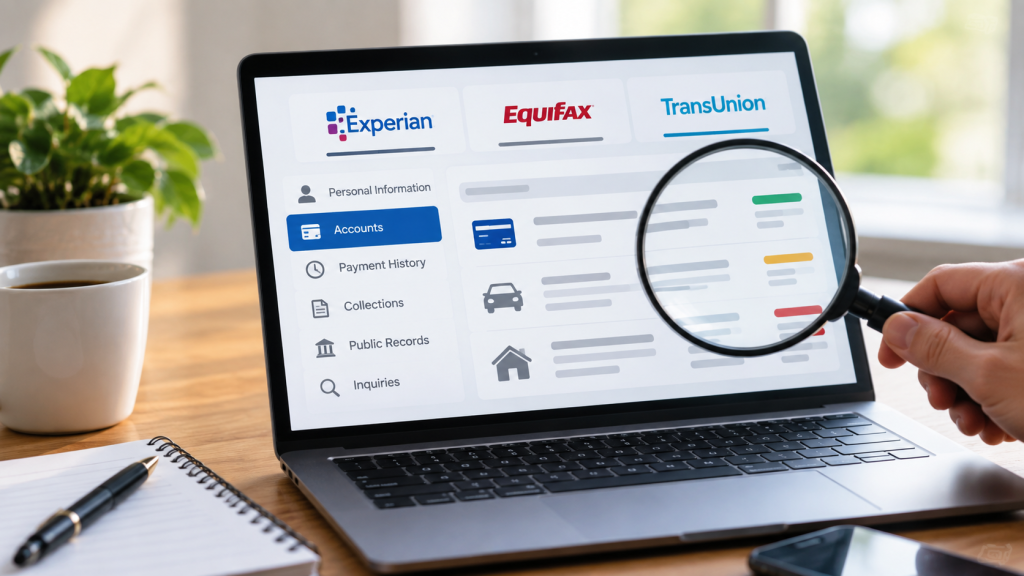
The first step is to find out exactly what the major credit reporting companies are reporting about you. Don’t assume that your reports are identical. Information can differ between credit reporting companies, so reviewing each available report can reveal discrepancies that might otherwise be missed.
Look closely at:
- Account names and account numbers
- Payment history
- Account status
- Current balances
- Collection accounts
- Charge-offs
- Repossessions
- Hard inquiries
- Personal information
- Duplicate accounts
- Accounts you don’t recognize
You are looking for information that does not appear to belong to you, does not match your records, or appears incomplete or incorrect. The Consumer Financial Protection Bureau recommends checking for identity errors, incorrect account statuses, wrong dates, duplicate debts, and incorrect balances or credit limits.
This is also why comparing reports matters. One bureau might contain information that another does not, or an account could be reported differently across files.
Step 2: Identify Information That May Be Wrong
This is one of the most important distinctions in credit repair:
“This hurts my credit” does not necessarily mean “this information is inaccurate.”
A collection account can negatively affect a credit profile while still being accurately reported. The same is true of a legitimate late payment, charge-off, or repossession.
Instead, investigate issues such as:
- An account that isn’t yours
- An incorrectly reported late payment
- A wrong balance
- A duplicate collection
- An incorrect account status
- Incorrect account dates
- An account associated with identity theft
- Information belonging to another consumer
- Potentially obsolete information
The question is not simply whether an item is negative. The question is whether the information is accurate, complete, properly associated with you, and otherwise being reported appropriately.
Step 3: Determine the Appropriate Way to Address Each Item
Not every credit-report problem should be handled in exactly the same way.
Depending on the circumstances, the appropriate path may involve a credit reporting company, the creditor or other data furnisher, a debt collector, or an identity-theft process.
You may also encounter terms such as the Fair Credit Reporting Act (FCRA), Fair Debt Collection Practices Act (FDCPA), debt validation, date of first delinquency, re-aging, and reinsertion.
You don’t need to become a legal expert to understand the basic idea: identify the specific problem first, then use the process that applies to that problem.
Step 4: Dispute or Request Correction of Questionable Information
A dispute should clearly identify what information is being challenged, why you believe it is incorrect, and what supporting documentation is available.
The CFPB recommends explaining in writing what you believe is wrong and providing copies of relevant supporting documents. It also recommends disputing inaccurate information with both the credit reporting company and the company that supplied the information, known as the furnisher.
After a dispute is submitted, several outcomes are possible:
- Deleted
- Corrected or updated
- Verified as reported
- Additional information requested
One important misconception needs to be cleared up here. A credit bureau does not simply have to delete everything because someone sends a dispute and a particular number of days passes. Credit reporting disputes involve an investigation process, and the outcome depends on the information and evidence involved. The CFPB says credit reporting companies generally must investigate disputes within 30 days, although certain situations can allow up to 45 days.
Step 5: Review the Results and Decide What Comes Next
Credit repair is not:
Send one letter → wait → magically get an 800 score.
After a dispute, review the response and check the updated credit report. Did the information actually change? Was the underlying problem corrected? Was the item verified? Is additional documentation or another legitimate step necessary?
This final review matters because the objective is not simply to send disputes. It is to determine whether an actual reporting problem was resolved and what should happen next.
What Can Credit Repair Potentially Address?
Credit repair can potentially address inaccurate, incomplete, duplicated, unauthorized, or otherwise legitimately disputable information. Whether an item can actually be corrected depends on the facts surrounding that account.
| Credit-report item | Can it potentially be disputed or corrected? |
|---|---|
| Collection accounts | If reported inaccurately or otherwise legitimately disputable |
| Charge-offs | Potentially, depending on reporting accuracy |
| Late payments | Potentially, if reporting is incorrect |
| Repossessions | Potentially, when report information contains errors |
| Medical collections | Depends on the circumstances and reporting |
| Hard inquiries | Potentially if unauthorized or otherwise improper |
| Identity-theft accounts | Special procedures may apply |
| Mixed-file information | Correction may be appropriate |
The key is that the negative nature of an account does not automatically make it disputable. Accurate information generally cannot simply be removed because it damages a credit profile.
What Credit Repair Cannot Do
Legitimate credit repair cannot guarantee deletion of accurate negative information. It also cannot lawfully invent a new credit identity, turn truthful information into false information, or guarantee a particular credit score.
It cannot guarantee approval for a mortgage, auto loan, credit card, or other financial product. And no credit repair service can control what a consumer does with their credit after the repair process.
The FTC specifically warns against companies that promise to remove accurate, current negative information or create a “new credit identity.”
The objective isn’t to make accurate information disappear. It’s to make sure your credit reports accurately reflect your credit history and to address information that legitimately warrants correction or dispute.
Does Credit Repair Actually Work?
Yes, legitimate errors and other legitimately disputable information can be corrected or removed through established credit-reporting processes. But saying that “credit repair works” does not mean every negative account will disappear.
When credit repair may help
Credit repair may be useful when reports contain errors, inconsistencies, identity-theft information, duplicate accounts, incorrect dates or account statuses, or other legitimate reporting problems.
When credit repair has limitations
If most negative information is accurate and properly reported, there may be little that a dispute-based repair process can change. Accurate negative information generally remains subject to the applicable reporting rules rather than being removed simply because it is unfavorable.
Why results vary
Every consumer has a different credit history. The number of derogatory accounts, type of reporting problems, available documentation, creditors involved, and overall credit profile can all affect the outcome.
For that reason, legitimate credit repair should never be presented as a guaranteed score-increase program.
Does Removing a Negative Item Increase Your Credit Score?
Credit report and credit score are not the same thing.
A credit score is calculated using information contained in a credit report, but changing one item does not produce a predictable point increase for every consumer.
The effect can depend on the rest of the credit profile and the scoring model being used. Removing or correcting an item could change a score, but the size and direction of the change should not be promised in advance.
This is why responsible credit repair focuses first on the accuracy of the underlying data rather than promising a specific number of points.
How Long Does Credit Repair Take?
There is no universal credit-repair timeline.
The process can depend on:
- The number of questionable items
- The nature of each issue
- The parties involved
- Available documentation
- How quickly responses are received
- Whether legitimate follow-up is necessary
For an individual dispute, a credit reporting company generally has 30 days to investigate, with some circumstances allowing a longer period.
That investigation timeline should not be confused with a promise that a person’s entire credit profile will be “repaired” within 30 days. Different issues can require different steps.
Can You Repair Your Credit Yourself?
Yes.
Consumers can review their own credit reports and dispute inaccurate information themselves. You do not need to hire a credit repair company simply to have the legal right to challenge inaccurate information.
A professional service may instead provide organizational and administrative value, such as:
- Reviewing multiple credit reports
- Identifying potential reporting problems
- Organizing documentation
- Understanding reporting details
- Managing the dispute process
- Tracking responses and changes
- Saving the consumer time
DIY may make sense if…
You have one or two straightforward errors, understand what appears on your reports, have supporting documentation, and feel comfortable handling the process yourself.
Professional assistance may make sense if…
You have multiple derogatory accounts or reporting issues, complicated reports, limited time, or simply prefer assistance managing the process.
The important point is that professional help should provide a service—not the illusion of secret access to the credit bureaus or special authority to force accurate information off a report.
How Do Credit Repair Companies Work?
A legitimate credit repair company’s workflow may look something like this:
Consumer onboarding
↓
Credit-report review
↓
Identification of potentially questionable reporting
↓
Action plan
↓
Appropriate disputes or corrections
↓
Monitoring and communication
↓
Results and next actions
The company does not control Equifax, Experian, TransUnion, creditors, collectors, or credit-scoring models. It works within the existing credit-reporting system.
That distinction matters. A legitimate company should not promise that it can force a bureau to delete accurate information or guarantee a specific score. The FTC and CFPB both identify promises of guaranteed score increases or removal of accurate negative information as warning signs.
How Much Does Credit Repair Cost?
Credit repair pricing varies by company and service model, so consumers should understand exactly what they are paying for before signing up.
Look at the contract carefully. Understand the services included, total cost, payment structure, cancellation provisions, and what the company actually promises to do.
Federal law also provides protections for consumers dealing with credit repair organizations, including requirements concerning disclosures and certain payment practices.
Read: How Much Does Credit Repair Cost?
Is Credit Repair Legal?
Yes. Credit repair itself is legal, and consumers have legitimate rights to dispute inaccurate information in their credit reports.
Several federal laws are relevant to the broader credit-reporting and credit-repair landscape, including:
- Fair Credit Reporting Act (FCRA)
- Credit Repair Organizations Act (CROA)
- Fair Debt Collection Practices Act (FDCPA)
The important distinction is between exercising legitimate dispute rights and using deceptive methods. False claims, fabricated information, false identity-theft reports, or attempts to create a new credit identity are not legitimate credit-repair strategies. The FTC specifically warns consumers about these practices.
How to Tell if a Credit Repair Company Is Legitimate
Before hiring a credit repair company, look for clear information about what the business actually does.
Useful things to investigate include:
- A clear explanation of services
- A written agreement
- Transparent pricing
- Applicable cancellation rights
- No guaranteed score increases
- No promise that every negative item will disappear
- No suggestion of creating a “new credit identity”
- No instruction to provide false information
- Clear communication about the consumer’s own rights
The FTC says credit repair companies must provide consumers with information about their rights and total costs and cannot legally make deceptive claims or charge consumers before providing services in violation of applicable requirements. Consumers also generally have a three-business-day right to cancel a credit repair contract without charge.
If a company tells you to dispute information that you know is accurate, that is another serious warning sign.
Is Credit Repair Worth It?
There is no universal answer.
Professional assistance may be worth investigating when someone has substantial credit-report problems, does not understand what is being reported, has difficulty organizing the documentation, or does not want to manage the process independently.
DIY credit repair may be sufficient for someone who has one obvious error and the time and confidence to handle the dispute.
The central question is:
What is actually wrong with your credit reports?
Once you know that, it becomes much easier to determine whether you need professional assistance or simply need to address a specific reporting error yourself.
What Should You Do Before Starting Credit Repair?
Before paying anyone for credit repair, take these basic steps:
- Get your credit reports.
- Review all reported accounts.
- Identify information you don’t recognize or believe is incorrect.
- Gather supporting records and documentation.
- Understand what is actually affecting your credit.
- Decide whether you want to handle the process yourself or seek assistance.
You can obtain your credit reports and review them before deciding whether professional help makes sense. The FTC notes that consumers can obtain free weekly reports through AnnualCreditReport.com.
Frequently Asked Questions About How Credit Repair Works
Can credit repair remove collections?
Potentially, if a collection account contains inaccurate, incomplete, duplicated, unauthorized, or otherwise legitimately disputable information. Accurate and current negative information cannot simply be removed because it is hurting your credit.
Can credit repair remove charge-offs?
A charge-off may be corrected if the information being reported is inaccurate or contains a legitimate reporting error. The fact that a charge-off is negative does not, by itself, make it removable.
Can credit repair remove late payments?
Potentially. If a late payment is being reported incorrectly, it can be disputed. An accurate late payment, however, is not automatically removable simply because it lowers a credit score.
Can credit repair remove a repossession?
It depends on the accuracy of the reporting. If the account, dates, balance, status, or other information is incorrect, the issue may be disputable.
Can credit repair remove hard inquiries?
Potentially, when an inquiry was not authorized or otherwise lacked a permissible purpose. Legitimate inquiries should not be disputed simply because they appear on a report.
Does credit repair hurt your credit?
Reviewing your credit reports or exercising your right to dispute inaccurate information is different from applying for new credit. A dispute itself should not be confused with a hard inquiry caused by a new credit application.
How fast can credit repair raise my score?
There is no guaranteed timeline or point increase. The effect depends on whether information is corrected, what changes on the reports, the rest of the credit profile, and the scoring model used.
Do credit repair companies have special powers?
No. Consumers have the right to dispute inaccurate information themselves. A credit repair company provides services around reviewing, organizing, and managing that process; it does not control the credit bureaus, creditors, or scoring models.
Find Out What’s Actually Hurting Your Credit
Not sure what’s actually holding your credit back?
Credit reports can contain collections, charge-offs, late payments, repossessions, incorrect account information, and other issues—and not every negative item should be handled the same way.
Credit Repair Dudes can review your situation and help you understand what may be addressable and what your next steps could be. The goal is not to promise that every negative item will disappear. It is to understand what’s actually being reported and identify legitimate ways to address problems.
R
Author Profile

-
Theodore Collins is a senior credit industry writer and consumer finance researcher at Credit Repair Dudes, with over a decade of hands-on experience analyzing credit reports, dispute strategies, and federal consumer protection laws. His work focuses on breaking down complex credit concepts into clear, actionable guidance for everyday consumers navigating collections, errors, and major financial decisions.
Before writing, Theodore worked closely with credit repair specialists and compliance teams, gaining real-world insight into FCRA, FDCPA, and CROA regulations, as well as the practical realities clients face when rebuilding credit. His articles are grounded in accuracy, transparency, and ethical standards, helping readers make informed decisions while holding the credit system accountable.
Latest entries
 UncategorizedSeptember 17, 2026 Can Credit Repair Remove Charge-Offs? What Can and Can’t Be Disputed
 UncategorizedSeptember 17, 2026 DIY Credit Repair vs. Credit Repair Companies: What’s the Difference?
 UncategorizedSeptember 17, 2026How Long Does Credit Repair Take? A Realistic Timeline From Dispute to Results
 UncategorizedSeptember 17, 2026How Much Does Credit Repair Cost? Fees, Pricing & What You Should Actually Pay