People don’t search for “free credit report” out of curiosity. They search because something just happened, or is about to.
Maybe you applied for credit and the approval didn’t go the way you expected. Maybe the rate was higher than it should’ve been. Maybe a lender, landlord, or insurer said no, without much explanation.
Or maybe you’re rebuilding and trying to figure out what’s actually on your file before making your next move.
For others, the trigger is fear, not planning. A strange account. A letter in the mail. A charge that doesn’t belong to them. When identity theft is even a possibility, the first instinct is to see the report.
That’s why this keyword has so much volume. It sits at the intersection of decision-making, damage control, and self-protection. But here’s where most people get tripped up.
A credit report is not the same thing as a credit score.
And “free” doesn’t always mean free, it often means free access until you’re pushed toward an upsell. Some sites show you a report. Some show you a score. Some show you part of both.
And some show you neither without collecting payment details first. That’s the confusion this page is meant to clear.
You’re entitled to a free credit report, but not every site offering one is equal.
What a Credit Report Actually Is (And Why It Matters)
A credit report is the raw file lenders pull from when they decide whether to approve you, and on what terms.
It’s not a number. It’s not a grade. It’s a record.
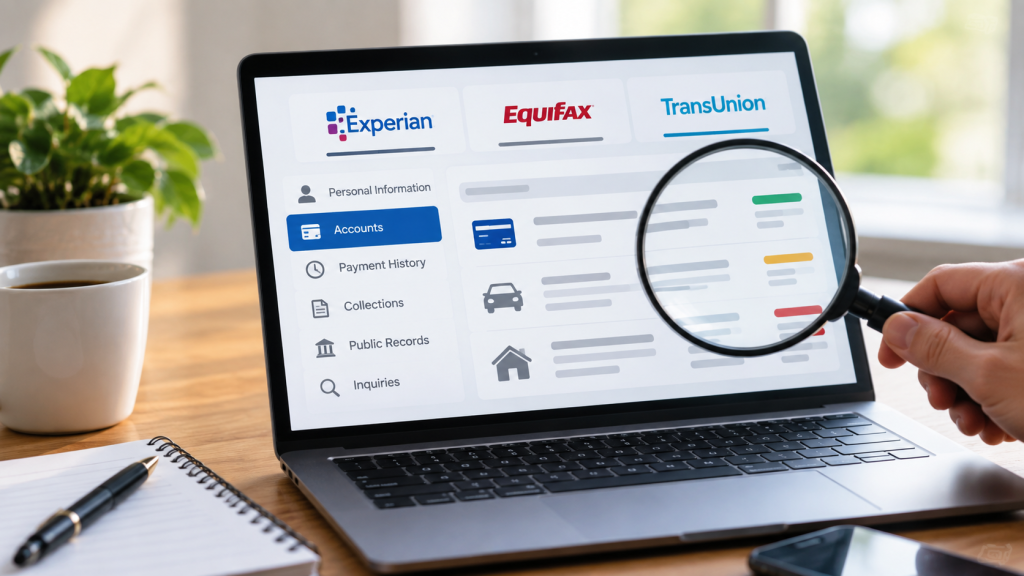
Specifically, your credit report contains:
- Personal information – Your name variations, current and past addresses, date of birth, and Social Security number markers used to match data to you.
- Account history – Credit cards, auto loans, student loans, mortgages, open and closed. Each account shows balances, limits, payment history, and status.
- Negative items – Collections, charge-offs, late payments, repossessions, foreclosures, and bankruptcies. These are the entries that usually cause denials and higher rates.
- Inquiries – A list of who has accessed your report and why. Hard inquiries matter for lending decisions. Soft inquiries don’t.
This is the file that gets evaluated. The score is just a mathematical interpretation of it. That distinction matters more than most people realize. A credit report is the source. A credit score is the output. You can improve a score temporarily by paying a balance down. But you can’t fix a wrong account, an outdated status, or an inaccurate collection without addressing the report itself.
That’s why reports matter more than scores when something is wrong. Scores fluctuate. Reports explain why.
If you’re trying to:
- correct errors
- resolve identity theft
- clean up old or inaccurate negatives
- understand a denial
The credit report is where the truth lives. Everything else is just a reflection of it.
The Only Official Source for Free Credit Reports by Law
When people search “free credit report,” they usually end up in a maze. Ads. Upsells. “Free” offers that quietly turn into subscriptions.
So let’s ground this in something simple and factual:
There is only one place authorized by federal law to give you your free credit reports.
Everything else is optional. Some are useful. Many are not.
AnnualCreditReport.com (The Authorized Site)
AnnualCreditReport.com is the only website authorized by the Federal Trade Commission (FTC) to provide free credit reports under the Fair Credit Reporting Act (FCRA).
Not “one of the options.”
Not “the best one.”
The only one.
This site exists because the law requires the credit bureaus to give you access to your data — not because a company wants to sell you something.
When you use AnnualCreditReport.com, you can pull your credit report from all three nationwide bureaus:
- Equifax
- Experian
- TransUnion
These are full credit reports.
Not summaries.
Not “insights.”
Not scores with marketing attached.
You’re seeing the same raw file lenders, landlords, and insurers see — just without a decision layered on top of it.
If your goal is accuracy, verification, or fixing something that’s wrong, this is where you start.
How Often You Can Get Free Reports
By law, you are guaranteed at least one free credit report every 12 months from each bureau.
That’s the minimum.
But current policy goes further.
Right now, you can:
- Check your credit report from each bureau once per week for free at AnnualCreditReport.com
- Receive additional free Equifax reports (six per year) through 2026, on top of the standard access
That means there is no reason to “save” your report or pay just to see what’s on it. If something changes, you can verify it. If something looks wrong, you can document it. If you’re preparing for a financial move, you can check before it costs you.
And importantly: AnnualCreditReport.com does not require a credit card. It does not enroll you in monitoring. It does not upsell you mid-process. It exists to give you access, nothing more. If a site claims to offer a “free credit report” but isn’t this one, it’s not illegal. But it’s not the same thing either. And knowing that difference protects you before anything else does.
How to Get Your Free Credit Report (Step-by-Step)
Getting your free credit report is straightforward, but it does require identity verification, because this is sensitive financial data, not a casual download. You can request your report online, by phone, or by mail through AnnualCreditReport.com. Online is the fastest option and gives you immediate access after you verify your identity. Phone requests are processed and mailed to you, usually arriving within about 15 days. Mail requests require completing the official Annual Credit Report Request Form and sending it in, and those typically take up to 15 days after receipt to process.
No matter which method you choose, you’ll need to verify who you are. That usually means providing your name, Social Security number, date of birth, and current address, and possibly a previous address if you’ve moved recently. You may also be asked security questions based on your credit file, such as loan amounts or past lenders, and each credit bureau may ask different questions. Once verified, you’ll receive your reports either instantly (online) or by mail. The process isn’t designed for convenience, it’s designed for accuracy and protection, which is exactly what you want when reviewing something this important.
Other Legit Ways to Get a Free Credit Report
AnnualCreditReport.com is the only official source required by law, but it’s not the only legitimate way to access your credit report for free. The key is understanding what you’re actually getting and where the line between free access and paid services starts.
You can request your credit report directly from the credit bureaus, Equifax, Experian, and TransUnion. Each bureau offers free access under certain conditions, such as after an adverse action (a denial or unfavorable decision), suspected identity theft, or when a fraud alert is placed on your file. Outside of those situations, they often provide limited free reports paired with optional paid monitoring or subscription plans. The report itself may be free, the extras usually are not.
Many banks, credit card issuers, and credit unions also provide free credit report access to their customers. This is typically offered as a value-added feature inside your account dashboard. The important distinction: some institutions give you actual report access, while others only show a credit score and summary. A score alone doesn’t show errors, account status, or reporting issues, so it’s not a substitute for reviewing the report itself.
You may also see credit monitoring services advertising free credit reports. These usually provide ongoing access to one bureau’s report or periodic snapshots in exchange for signing up. While this can be useful for tracking changes over time, it often comes with limitations, such as single-bureau coverage, delayed updates, or heavy upsell prompts. Monitoring confirms that something changed; it doesn’t explain why or fix inaccuracies on its own.
Situations Where You’re Entitled to an Extra Free Credit Report
Beyond the standard free reports, federal law gives you the right to additional free credit reports in specific situations. These aren’t loopholes or promotions, they’re protections built into the system for moments when your credit file directly affects your life.
If you’ve been denied credit, offered worse terms than expected, or received any unfavorable decision based on your credit, you’re entitled to a free report from the bureau that supplied the information. This is called an adverse action. You typically have 60 days from the notice to request that report, and it’s one of the most important times to review your file because errors often surface here.
You’re also entitled to a free credit report if your credit is checked for employment purposes and the decision goes against you. Employers can’t pull your credit without consent, and if it plays a role in a negative outcome, you have the right to see exactly what was reviewed.
If you’re dealing with identity theft or suspected fraud, the law allows you to access free reports so you can monitor and correct damage. The same applies if you’ve placed a fraud alert on your credit file, alerts exist to protect you, and free report access is part of that protection.
Lastly, individuals who are unemployed and actively seeking work or receiving public assistance may also qualify for extra free reports. These provisions exist to ensure access to credit information during financially vulnerable periods, when mistakes, outdated data, or fraudulent accounts can cause the most harm.
Knowing these rights matters. Not because you’ll use them every year, but because when something goes wrong, you’re not locked out of your own information.
Free Credit Report vs. Free Credit Score
This is where most of the confusion starts, and where a lot of “free credit report” ads quietly blur the lines.
Many sites that advertise a free credit report are actually giving you a free credit score instead. Usually a VantageScore. Usually paired with monitoring. And usually enough to make it feel like you’re seeing the whole picture, even when you’re not.
A credit score is a number. It’s a summary. A snapshot. It reacts to what’s on your file, but it doesn’t show you why things look the way they do. You can’t fix errors from a score alone, and you can’t see what a lender is actually reviewing.
A credit report, on the other hand, is the source document. It shows your personal information, every account being reported, balances, payment history, collections, charge-offs, inquiries, and public records. This is the file lenders pull. This is where mistakes live. And this is what you need if you’re trying to understand denials, higher rates, or unexplained score drops.
That’s why so many “free report” offers lean on scores, they’re easier to show, cheaper to provide, and don’t require exposing the full data. But a score without the report behind it is like a temperature reading without knowing what’s causing the fever.
If you have to choose one to check first, start with the credit report. Always. Scores help you monitor movement. Reports tell you what actually needs to be fixed.
How to Read Your Credit Report (What to Look For)
Getting your credit report is only step one. The real value comes from knowing what to look at, and what actually matters.
Start with your personal information. Names, addresses, employers, and variations of your Social Security number should all be accurate. Incorrect personal data might seem harmless, but it can signal mixed files or identity issues that bleed into account reporting.
Next, review every account listed. If you see an account you don’t recognize, don’t assume it’s yours just because it’s familiar-looking. Old medical collections, retail cards, or telecom accounts are common sources of reporting errors, especially after moves or name variations.
Pay close attention to late payments. Look for dates that don’t line up with your records, payments marked late when they weren’t, or late marks that continue after an account was brought current. Even one incorrectly reported late payment can drag a file down for years.
Watch for duplicate accounts or re-aged debt. The same collection should not appear multiple times under different names, and old debt should not be “reset” to look newer than it is. This happens more often than people realize.
Finally, scan all collections and charge-offs carefully. If a collection doesn’t belong to you, was already paid, or lacks clear documentation, it doesn’t deserve to be there. These are often the most damaging items, and the most likely to contain errors.
Reading your credit report isn’t about panic or perfection. It’s about spotting inaccuracies, patterns, and problems early, before they turn into denials, higher rates, or unnecessary stress.
What to Do If You Find Errors
Finding an error on your credit report doesn’t mean your credit is “bad.” It means the data may be wrong, and wrong data is fixable.
If you spot inaccurate or incomplete information, you have the right to dispute it with the credit bureau reporting it. Disputes aren’t about arguing your case emotionally; they’re about forcing verification. If a bureau or creditor can’t confirm that an item is accurate and complete, it doesn’t legally belong on your report.
For collections and charged-off accounts, you also have debt validation rights. That means you can require the collector to prove the debt is yours, accurate, and legally collectible. If they can’t validate it properly, they cannot continue reporting it as fact.
Pay close attention to timeline errors. Accounts should not be re-aged to appear newer than they are, late payments shouldn’t continue after an account is current, and negative items must fall off when legally required. These reporting violations are common, and often overlooked.
The key thing to understand is this: errors matter more than your score. Scores are just the output. The report is the input. Fixing inaccurate data is what creates real, lasting improvement, not chasing quick score bumps or watching numbers fluctuate.
Credit repair, at its core, isn’t about gaming the system. It’s about enforcing accuracy.
How Free Credit Reports Help Prevent Identity Theft
One of the most overlooked benefits of pulling your free credit report is early detection. Identity theft rarely starts loud. It usually starts quietly, a new account here, an inquiry there, long before a bank calls or a bill shows up.
Your credit report lets you spot early warning signs that something’s wrong. Accounts you don’t recognize. Credit cards or loans you never opened. Addresses, employers, or names that aren’t yours. These are not small details, they’re red flags.
Unauthorized hard inquiries are another signal. Even if no account was approved, an inquiry you didn’t authorize can mean someone tried to use your identity. Catching this early can stop damage before it spreads.
If you see activity that clearly isn’t yours, that’s when monitoring turns into action. At that point, you should escalate beyond the credit bureaus and report the issue through IdentityTheft.gov, which creates an official record and recovery plan. This step matters, it documents fraud and gives you legal footing to correct your reports.
The takeaway here is simple: credit reports aren’t just about borrowing money. They’re one of your best defensive tools. Checking them regularly isn’t paranoia, it’s prevention.
Should You Pull All Three Reports at Once, or Stagger Them?
This is one of those questions where the right answer depends on what you’re trying to accomplish, not a one-size-fits-all rule.
If you pull all three credit reports at once (Equifax, Experian, and TransUnion), you get a full snapshot of your credit file in the same moment. This approach makes sense if you’re preparing for something specific, applying for a loan, dealing with a denial, addressing suspected fraud, or starting credit repair. Seeing everything at once helps you catch inconsistencies between bureaus and prevents surprises later. When timing matters, this is usually the smarter move.
Staggering your reports throughout the year is more of a monitoring strategy. Instead of pulling all three at once, you check one bureau every few months. This creates a rolling review cycle that helps you spot changes, new accounts, or errors sooner, especially useful if you’re rebuilding credit or want ongoing visibility without paying for monitoring.
So which approach fits which situation?
- Pull all three at once if you’re fixing problems, verifying accuracy, or preparing for a financial decision.
- Stagger them if your credit is relatively stable and you want continuous awareness over time.
Both options are valid. The mistake is not using either, or assuming one report tells the full story. Each bureau can show different information, and how you time your reviews determines whether you’re reacting late or staying ahead.
Beware of “Free Credit Report” Scams
This part matters more than most people realize, because “free credit report” is one of the most abused phrases in the credit space.
There is only one website authorized by federal law to provide the free credit reports you’re entitled to: AnnualCreditReport.com. Anything else may still offer something, but it’s not the same thing, and it often comes with strings attached.
Here are the most common red flags to watch for:
- Misspelled or look-alike URLs – Scam sites intentionally use URLs that resemble the official site, hoping you mistype or don’t notice small differences.
- Mandatory credit card entry – If a site requires a credit card just to “access” your free report, it’s not the legally mandated free report. That’s a sales funnel.
- Forced subscriptions or trial traps – Many sites advertise “free,” then quietly enroll you in paid monitoring unless you cancel. Free should not require cancellation.
It’s also important to know what the real site doesn’t do.
AnnualCreditReport.com will never email you, call you, or ask for personal information through unsolicited messages. If you receive an email, pop-up, or phone call claiming to be from them or a credit bureau asking for your Social Security number or account details, that’s a scam.
If you encounter a suspicious site, misleading ad, or fraudulent credit-related offer, you can report it directly to the Federal Trade Commission at ReportFraud.ftc.gov. While they can’t fix individual cases, these reports help shut down bad actors and protect others.
When it comes to your credit, free should mean free, not confusing, not conditional, and not risky.
How Free Credit Reports Fit Into Credit Repair
Free credit reports are where real credit repair actually begins, not with scores, not with apps, and not with guesses.
Your credit report is the raw data lenders see. Every late payment, collection, charge-off, balance, and personal detail lives there. If something is wrong, outdated, duplicated, or unverifiable, it’s the report, not the score, that needs attention. That’s why reports are the foundation of any legitimate repair process.
You can’t fix what you can’t see.
A score might tell you something is off. A credit report tells you exactly what and why. That’s the difference between monitoring and correction. Monitoring shows changes after they happen. Correction is how those changes are made in the first place.
This is also where a lot of people get stuck. They check their reports, see issues, and assume watching them over time will somehow make those issues disappear. It doesn’t. Inaccurate reporting doesn’t self-correct. Old accounts don’t magically become compliant. Errors stay put unless they’re challenged properly.
That’s when professional help becomes relevant, not as a shortcut, but as a structured way to:
- identify reporting violations,
- validate questionable debts,
- dispute inaccuracies correctly, and
- manage timelines and compliance.
Free credit reports don’t fix credit on their own. But without them, fixing credit isn’t even possible.
FAQ: Free Credit Reports
Where can I get a free credit report?
You can get your official free credit reports from AnnualCreditReport.com, the only website authorized by federal law. It lets you access your credit reports from Equifax, Experian, and TransUnion at no cost.
Is AnnualCreditReport.com legit?
Yes. AnnualCreditReport.com is completely legitimate and federally authorized by the FTC. It’s the only site required by law to provide free credit reports. It does not require a credit card and does not upsell subscriptions.
How often can I get a free credit report?
By law, you’re entitled to one free report per bureau every 12 months. In addition, current policy allows you to check all three reports weekly for free at AnnualCreditReport.com. Equifax also offers additional free reports through 2026.
Do free credit reports hurt my credit?
No. Checking your own credit report is a soft inquiry and has zero impact on your credit score.
Is Credit Karma a free credit report?
Not exactly. Credit Karma provides free credit reports from Equifax and TransUnion, but it does not give you Experian reports and it pairs those reports with VantageScore, not FICO®. It’s useful for monitoring, but it’s not the same as pulling your official reports from all three bureaus.
Can I get all three credit reports for free?
Yes. AnnualCreditReport.com allows you to access Equifax, Experian, and TransUnion reports for free, either all at once or individually, depending on how you choose to review them.
Author Profile

-
Theodore Collins is a senior credit industry writer and consumer finance researcher at Credit Repair Dudes, with over a decade of hands-on experience analyzing credit reports, dispute strategies, and federal consumer protection laws. His work focuses on breaking down complex credit concepts into clear, actionable guidance for everyday consumers navigating collections, errors, and major financial decisions.
Before writing, Theodore worked closely with credit repair specialists and compliance teams, gaining real-world insight into FCRA, FDCPA, and CROA regulations, as well as the practical realities clients face when rebuilding credit. His articles are grounded in accuracy, transparency, and ethical standards, helping readers make informed decisions while holding the credit system accountable.
Latest entries
 UncategorizedSeptember 17, 2026 Can Credit Repair Remove Charge-Offs? What Can and Can’t Be Disputed
 UncategorizedSeptember 17, 2026 DIY Credit Repair vs. Credit Repair Companies: What’s the Difference?
 UncategorizedSeptember 17, 2026How Long Does Credit Repair Take? A Realistic Timeline From Dispute to Results
 UncategorizedSeptember 17, 2026How Much Does Credit Repair Cost? Fees, Pricing & What You Should Actually Pay