Credit scores are often treated like a single number you only check when you need a loan. In reality, they quietly influence far more than borrowing. From interest rates and credit limits to rental approvals, deposits, and even insurance pricing, your credit score affects how much things cost, what you’re allowed to access, and when you’re able to move forward.
That’s why small differences matter. A few points can mean the difference between approval and denial, or thousands of dollars in extra interest over time. And none of it is personal. Lenders aren’t judging character or effort, they’re pricing risk based on patterns in your credit history.
A credit score isn’t a judgment. It’s a risk measurement.
What a Credit Score Is
A credit score is a summary of how risky you look to a lender, based on your past credit behavior. It takes everything on your credit reports, payments, balances, account age, and activity, and compresses it into a single number that helps decision-makers move fast.
Think of it as a shorthand for creditworthiness. Instead of reading every line of your credit report, lenders use a score to estimate how likely you are to repay what you borrow on time.
Most credit scores fall within a 300–850 range. The higher the number, the lower the perceived risk. A higher score doesn’t mean you’re “better” — it means your past behavior fits patterns that lenders associate with reliability. Lower scores signal uncertainty, missed payments, or heavier usage, which lenders price accordingly.
It’s not a moral grade. It’s a statistical snapshot.
How Lenders Use Credit Scores
Lenders use credit scores to make fast, consistent decisions about risk. When you apply for credit, your score helps determine whether you’re approved, how much you can borrow, and what it will cost you over time.
In practice, credit scores influence:
- Loan approvals and denials, often as an initial screening tool
- Interest rates and loan terms, where higher scores usually unlock lower rates
- Credit limits, affecting how much access you’re given
- Renting and security deposits, especially with property managers
- In some cases, employment-related checks, where permitted by law
There’s no single score that guarantees approval everywhere. Each lender sets its own thresholds based on risk tolerance, product type, and market conditions. That’s why two lenders can look at the same profile and make different decisions. Credit scores guide outcomes, they don’t dictate them.
The Difference Between a Credit Score and a Credit Report
A credit report is the source document. A credit score is the summary built from it.
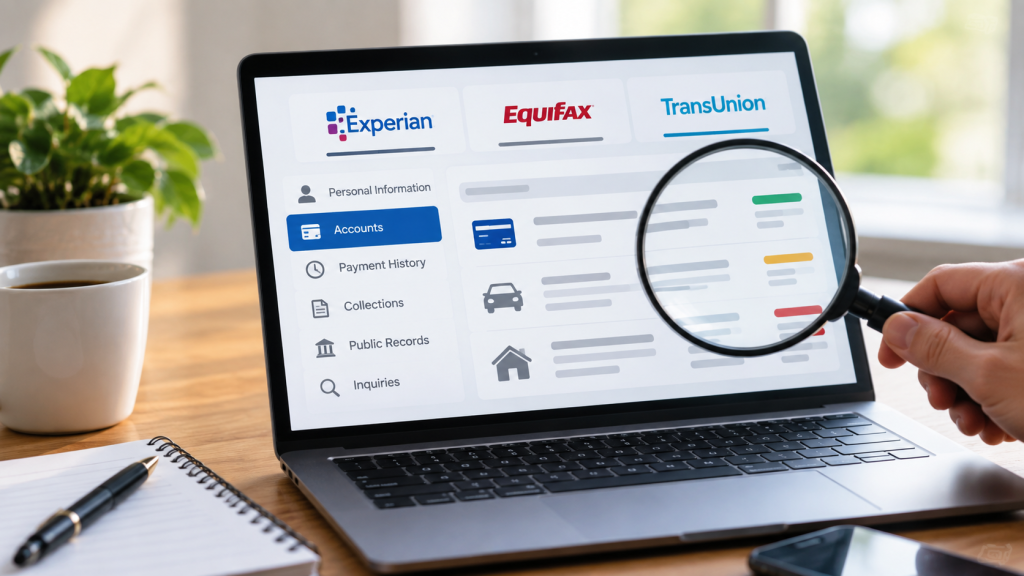
Your credit report contains the raw details of your credit history: personal information, open and closed accounts, payment history, balances, collections, charge-offs, public records, and inquiries. It’s maintained separately by each credit bureau and updated as lenders report activity.
A credit score is calculated from that information using a scoring model. Change the data in the report, and the score changes with it. But chasing the number without addressing what’s underneath is backwards.
That’s why real progress starts with the report. Errors, outdated information, or misreported accounts affect scores across the board. Fix the report, and the score follows. Chase the score alone, and you’re reacting to symptoms instead of causes.
About FICO® Scores (The Industry Standard)
When people say “credit score,” they’re usually talking about a FICO® Score, whether they realize it or not.
FICO® Scores are created by Fair Isaac Corporation (FICO), the company that pioneered modern credit risk scoring decades ago. Today, roughly 90% of top lenders rely on FICO® Scores when making decisions about mortgages, auto loans, credit cards, and other forms of credit. That level of adoption is why FICO became the default language of lending.
This is also why the terms credit score and FICO score get used interchangeably in everyday conversation. While other scoring models exist, FICO® is the one most lenders actually price risk with.
FICO® Scores are calculated using data from the three major credit bureaus:
- Experian
- Equifax
- TransUnion
Each bureau maintains its own version of your credit report, and FICO® can generate a score from any one of them. That’s why you don’t have just one FICO® Score, you have multiple, depending on which bureau’s data is used and which FICO model a lender pulls.
Understanding that structure matters, because lenders aren’t guessing. They’re using a standardized risk framework that’s been refined, tested, and embedded into the financial system for decades.
Credit Score Ranges Explained
Credit scores are often talked about in exact numbers, but lenders usually think in ranges, not single points. Where you fall within a range matters more than whether your score moved up or down a few points this month.
Here’s how most lenders interpret scores on the standard 300–850 scale:
- Poor (below 580) – Signals high risk. Approvals are difficult, terms are expensive, and options are limited.
- Fair (580–669) – Below average. Some approvals are possible, but usually with higher interest rates, lower limits, or added conditions.
- Good (670–739) – Around or above the national average. Most lenders view this as acceptable risk, with solid approval odds and reasonable terms.
- Very Good (740–799) – Low risk. Borrowers in this range typically qualify for better rates, higher limits, and more flexibility.
- Exceptional (800+) – Very low risk. This range signals long-term, consistent credit management and unlocks the best available offers.
What matters most isn’t whether your score is 712 or 718, it’s which range you’re in and how lenders price that level of risk. Once you cross into a higher range, the financial impact is usually much larger than small point fluctuations within the same band.
How a Credit Score Is Calculated
Credit scores aren’t arbitrary. They’re built from patterns that lenders have studied for decades to predict repayment behavior. While the exact formulas are proprietary, the core ingredients are public, and understanding them helps you focus on what actually moves the needle.
The Five Core Factors (FICO® Model)
In the FICO® scoring model, factors are weighted roughly as follows:
- Payment history (35%) – Whether you pay on time. Late payments, collections, and charge-offs weigh heavily because they signal repayment risk.
- Amounts owed / utilization (30%) – How much of your available credit you’re using, especially on revolving accounts like credit cards. High utilization suggests financial strain.
- Length of credit history (15%) – The age of your accounts, including the oldest account and average account age. Longer history provides more data and lowers uncertainty.
- Credit mix (10%) – Experience managing different types of credit, such as credit cards, auto loans, and mortgages.
- New credit / inquiries (10%) – Recent applications and newly opened accounts. Too much activity in a short time can signal elevated risk.
What This Means in Practice
Two factors dominate most outcomes: payment history and utilization. Missed payments or maxed-out cards can outweigh almost everything else.
Not every action produces instant movement. Paying off a card, opening a new account, or resolving an issue may take time to report and cycle through scoring models. And timing matters, changes right before an application can help or hurt depending on how and when they’re reported.
Credit scores respond to patterns, not one-off gestures. Consistency over time is what recalibrates risk.
Why Credit Scores Differ Between Bureaus
It’s common to see different credit scores from different bureaus, and it doesn’t mean something is wrong. It means the data isn’t perfectly synchronized.
Here’s why differences happen:
- Different reporting by lenders – Not every lender reports to all three bureaus. Some report to one or two, which means each bureau may be working with slightly different information.
- Timing of updates – Even when lenders report to all bureaus, they may update one earlier than another. A payment, balance change, or closure can show up in one place weeks before it appears elsewhere.
- Errors appearing on one bureau only – Mistakes don’t always replicate across all three reports. A duplicate account, wrong balance, or outdated status can affect one score while the others remain clean.
- Bureau-specific scoring models – The same scoring model (like FICO® Score 8) can produce different results depending on which bureau’s data is used. And some lenders use bureau-specific or industry-specific versions.
Sometimes these differences are small, a few points that don’t change outcomes. Other times, they can push you into a different score range and cost real money through higher rates, lower limits, or delayed approvals. That’s why reviewing all three reports matters, not just one number.
Why Credit Scores Change Over Time
Credit scores aren’t permanent labels. They’re snapshots, reflections of what your credit profile looks like at a specific moment.
Scores change as the information in your credit reports changes. Common reasons include:
- Payments and missed payments – On-time payments strengthen your profile over time. Late or missed payments can cause immediate drops, especially if they’re recent.
- Balance changes and utilization – Paying down credit cards can help, while higher balances can hurt, particularly when utilization crosses certain thresholds.
- New accounts and inquiries – Applying for or opening new credit can cause temporary dips as risk increases and account age resets.
- Account aging – As accounts get older and negative items become less recent, their impact can fade.
The key is understanding that a score reflects current risk, not past mistakes forever. Behavior changes, data updates, and time all reshape the picture. That’s why credit is something you manage, not something you’re stuck with.
FICO® Scores vs Other Credit Scores
Not all credit scores are the same, even when they’re built from the same credit report.
The two names you’ll see most often are FICO® Scores and VantageScore®, and understanding the difference clears up a lot of confusion.
FICO® Scores are the industry standard. Roughly 90% of top lenders rely on them when making real approval and pricing decisions. These models are designed specifically to predict lending risk and have decades of adoption behind them.
VantageScore®, on the other hand, was created by the credit bureaus as an alternative scoring model. It’s commonly used by free consumer platforms because it’s easier to distribute at scale. That’s why many “free credit score” apps show a number that doesn’t match what a lender sees.
This is where people get tripped up.
A free score can be accurate within its own model, but still irrelevant to a lender using a different one. Both scores can move up or down correctly based on your data, yet land at very different numbers because they weigh risk differently.
That’s why these scores aren’t interchangeable.
A FICO® Score answers the question lenders care about: How risky is this borrower for this specific product?
Other scores are better viewed as educational tools, useful for trends and awareness, but not decision-grade.
If you’re monitoring progress, free scores are fine.
If you’re applying, negotiating, or planning timing, the model matters more than the number.
Minimum Requirements to Have a Credit Score
You don’t automatically have a credit score just because you exist, there are minimum data requirements before any scoring model can calculate one.
In most cases, you need at least one credit account that’s been open for six months or longer. That gives the scoring model enough history to analyze behavior, not just a snapshot. You also need recent activity, meaning at least one account must have been reported to a credit bureau within the last six months.
If either of those conditions isn’t met, you may show up as having no score.
This is common for:
- People new to credit
- Individuals who closed all accounts years ago
- Anyone who hasn’t used credit recently
You’ll also hear the term “thin file.” That means a score exists, but it’s based on very limited information, maybe one card or a single loan. Thin files can still produce scores, but they’re more volatile and often viewed as higher risk by lenders.
The key takeaway: no score doesn’t mean bad credit. It usually means not enough data yet. And thin credit isn’t about fixing mistakes, it’s about building usable history over time.
How to Check Your Credit Score
Checking your credit score is easy, understanding which score you’re actually looking at is the part most people miss.
There are plenty of free options available today. Many banks and credit card issuers show a credit score inside your account dashboard. The credit bureaus themselves also offer free access tools. These options are convenient and good for general awareness, especially if you’re just monitoring trends.
But here’s what “free” usually means in practice:
- You’re often seeing one score, not all of them
- It’s typically FICO® Score 8 or a VantageScore® model
- It usually reflects one credit bureau, not all three
That’s not a problem, as long as you understand the limitation.
Paid access starts to make sense when you’re preparing for a major financial move. That’s when you may want:
- Scores from all three bureaus
- Industry-specific FICO® scores (mortgage, auto, credit card)
- Planning and tracking tools that show how actions affect lender models
Most people don’t need paid access all the time. But if you’re applying soon, negotiating rates, or trying to time a decision, it can prevent expensive surprises.
The most important part isn’t how you check your score, it’s knowing which score you’re seeing and why it exists. A number without context can be misleading. Understanding the model behind it is where real clarity comes from.
Common Credit Score Myths
A lot of bad financial decisions don’t come from laziness, they come from misunderstanding how credit actually works. These are the myths that trip people up the most.
“There’s only one credit score.”
In reality, you have dozens of scores. Different bureaus, different models, different versions, all built from similar data, but calculated differently. The idea of a single, universal score is one of the biggest oversimplifications in personal finance.
“Paying everything fixes scores instantly.”
Paying off debt is good, but it doesn’t automatically translate into an immediate score jump. Scores update when data is reported, models recalculate, and utilization or history changes are reflected. Timing matters, and so does how the account is reported after payment.
“All lenders use the same model.”
They don’t. Mortgage lenders, auto lenders, and credit card issuers often use different versions of FICO® scores, sometimes older ones, sometimes industry-specific ones. What looks “good” in one system may not carry the same weight in another.
“Free scores equal lender scores.”
Free scores are helpful, but they’re usually educational or consumer-facing models. Lenders rarely use the exact score you see for free. That doesn’t make free scores useless; it just means they’re context tools, not decision tools.
Understanding these myths isn’t about being cynical, it’s about avoiding false confidence. Credit works best when you treat it as a system, not a shortcut.
How Credit Scores Fit Into Credit Repair
Credit repair isn’t about chasing a higher number. It’s about making sure the data behind the number is correct.
Scores are outputs. Reports are inputs.
Repair happens at the report level, not inside an app, and not by obsessing over daily score swings.
The core of legitimate credit repair is accuracy:
- Are accounts reported correctly?
- Are dates accurate?
- Are balances, statuses, and ownership valid?
- Is negative information legally reportable?
When something is wrong, repair focuses on fixing the source, not the symptom.
That’s where tools like:
- Disputes come in — to challenge inaccurate, incomplete, or unverifiable information.
- Debt validation matters — to force collectors to prove a debt is legitimate and legally reportable.
- Timeline and reporting errors become critical — late payments reported on the wrong dates, accounts re-aged improperly, or negatives lingering past their allowed reporting period.
This is also why monitoring alone doesn’t fix credit.
Monitoring tells you that something changed.
Repair determines whether it should have changed at all.
Watching a score move without correcting underlying errors can create false confidence — or unnecessary panic. Real improvement comes from cleaning up what lenders actually see, not reacting to surface-level fluctuations.
Credit repair, when it’s done right, is quiet.
It’s procedural.
And it’s focused on correctness, not hype.
Who Should Pay the Closest Attention to Their Credit Score
Not everyone needs to watch their credit score obsessively.
But for certain situations, timing and awareness matter a lot.
Home buyers sit at the top of the list. Mortgage approvals, interest rates, and even loan programs are heavily score-sensitive. Small differences can mean thousands of dollars over the life of a loan, and lenders often use older or industry-specific FICO® models that behave differently than consumer apps.
Auto loan shoppers also need to pay close attention. Auto lenders frequently use auto-enhanced FICO® scores, and the gap between score tiers can directly affect monthly payments, required down payments, and dealer financing options.
Credit rebuilders should monitor their scores to track progress, not perfection. The goal isn’t daily movement, but confirming that corrections, payments, and balance changes are being reflected over time. Scores help signal whether repair efforts are working, but they should always be viewed alongside the credit report itself.
Anyone planning a major financial move, applying for a loan, negotiating rates, changing housing, or restructuring debt, should treat their credit score as a planning tool. Checking it too late can limit options. Understanding it early creates leverage.
In short, credit scores matter most when decisions are being made.
If money, timing, or approval is on the line, awareness becomes strategy, not anxiety.
Final Takeaway
A credit score isn’t a judgment of you, it’s a risk measurement tool used by lenders to make decisions quickly.
What matters most isn’t chasing a higher number, but knowing which score is being used, when it’s being pulled, and why it moves the way it does. A 20-point swing means very different things depending on the model, the bureau, and the type of application.
When you understand how the system works, credit stops feeling unpredictable.
You stop reacting, and start planning.
That’s the real advantage: clarity creates leverage, not fear.
FAQ Section
What is a credit score?
A credit score is a numerical snapshot of how risky you look to a lender at a specific moment in time. It’s calculated from the information in your credit report and is designed to predict how likely you are to repay a debt. Higher score = lower perceived risk.
What is a good credit score?
Generally, a score between 670–739 is considered “good.” That range usually qualifies for standard approvals and reasonable rates. Above that (740+) is where borrowing gets cheaper and easier. Below that doesn’t mean “bad person” — it just means higher risk in the lender’s eyes.
Is a FICO® score the same as a credit score?
Not exactly. “Credit score” is the generic term. FICO® Score is a specific scoring model, and the one used by about 90% of top lenders. Many apps show other scores, but when lenders decide, they’re usually looking at FICO.
Why are my credit scores different?
Because:
- Not all lenders report to all three bureaus
- Updates happen at different times
- Different scoring models weigh factors differently
- Errors can appear on one report but not another
Same person. Same credit behavior. Different data inputs = different scores.
Can I check my credit score for free?
Yes. Many banks, credit cards, and credit bureaus provide free scores. Just know what you’re getting: it’s often one score, one bureau, and one model. Free access is great for awareness, just don’t assume it’s the exact score a lender will use.
How often does my credit score change?
Any time your credit report changes. Payments posting, balances updating, accounts aging, new inquiries, all of that can move a score. Credit scores aren’t permanent labels; they’re live measurements that update as data changes.
Author Profile

- Michael Harrington is a senior credit analyst and contributor at Credit Repair Dudes, specializing in consumer credit reporting, dispute methodology, and long-term credit profile improvement. With extensive experience analyzing bureau data, lender behavior, and FCRA compliance, Michael focuses on helping consumers understand how credit decisions are actually made, and how to protect and improve their credit responsibly. His work emphasizes accuracy, transparency, and practical strategy over shortcuts or gimmicks.
Latest entries
 Credit EducationFebruary 20, 2026Legal Harbor Review (2026) — Is It Legit or Worth It?
 Credit EducationFebruary 8, 202620 Credit Report Terms Everyone Should Know Before Applying for a Loan
 Credit EducationFebruary 3, 2026What to Do When a Collection Agency Calls You, Step by Step Guide
 Credit EducationJanuary 26, 2026Sky Blue Credit Repair Reviews — In-Depth, Neutral Analysis