Most people grow up thinking credit is a score, a single number that rises when you’re “good” and falls when you’re “bad.” Lenders don’t see it that way. To them, credit is raw data: dates, balances, statuses, histories, patterns. And here’s the part almost nobody explains, the law doesn’t regulate scores at all. It regulates data. That disconnect is why people pay on time, lower balances, follow advice, and still get denied. They’re fixing the number while the system is judging the record underneath it.
The Consumer Report and the Credit Score Are Not the Same Thing
A credit score is an algorithm, a mathematical model that reacts to what’s on your file. A consumer report is a legal document, a record of reported facts governed by federal law. One cannot exist without the other, but only one is protected by statutes like the FCRA. Lenders don’t dispute scores; they evaluate reports. And regulators don’t correct algorithms; they enforce accuracy, completeness, and verification of records. That’s the distinction most fixes miss. You don’t fix algorithms. You correct records.
What the Law Actually Defines as a “Consumer Report”
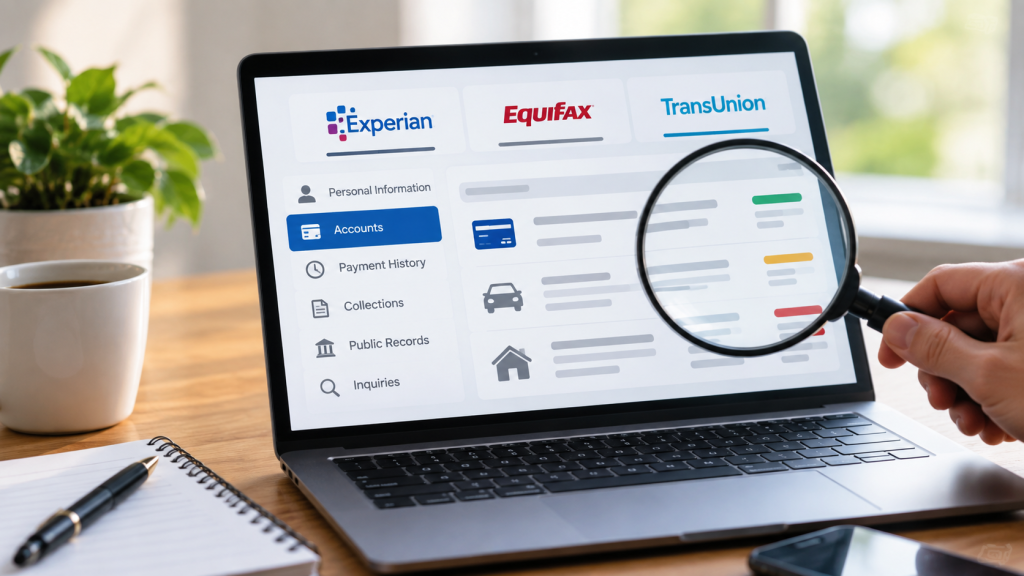
Under 15 U.S.C. §1681, Congress doesn’t talk about “credit scores” at all. It defines a consumer report as any written, oral, or electronic communication from a consumer reporting agency that bears on your creditworthiness, character, reputation, personal characteristics, or mode of living, and is used (or expected to be used) to decide whether you get credit, a job, housing, insurance, or another financial opportunity. In plain English: a consumer report is the record lenders and institutions rely on to judge risk. It can include account histories, balances, payment behavior, public records, collections, inquiries, and identifying information, but it must be accurate, verifiable, and legally reportable. Congress explicitly excludes things like internal notes, marketing data, or information not used for eligibility decisions. This matters because the law governs what can be reported and how it must be handled, not how an algorithm scores it. That’s why corrections, disputes, and deletions operate at the data level, because legally, that’s the only place your rights exist.
Why Payment History and Utilization Are Scoring Factors, Not Report Factors
This is where most people get lost. Payment history and utilization are tools used by scoring models, not requirements of a credit report itself. FICO and other algorithms interpret behavior to estimate risk, but the law doesn’t require those interpretations to exist on your file. A consumer report only contains data that a furnisher is legally allowed to report, for a legally permitted purpose, with proper disclosure and verification. Missed payments, balances, and limits don’t automatically belong on a report just because they happened; they become reportable only when a creditor chooses to furnish them under specific rules. That’s the disconnect: people try to “fix” how algorithms think instead of correcting whether the underlying data should be there at all. Algorithms react. Records are regulated. And only one of those can be challenged under federal law.
The Hidden Reason Late Payments and Balances Stay on Reports
Late payments and high balances don’t stay on credit reports because they’re unbeatable, they stay because almost nobody challenges whether they were allowed to be reported in the first place. Most consumers argue accuracy (“Yes, I was late”), when the real question is authorization (“Were you legally permitted to report this data, in this way, for this purpose?”). Credit bureaus run on automation, volume, and assumptions, not individualized legal review. When a consumer stays silent or disputes the wrong way, the system treats that silence as practical consent, even though the law never says silence equals agreement. That’s why negative data survives for years: not because it’s invincible, but because it’s rarely questioned at the level the law actually recognizes.
Opt-Out Rights and Privacy, The Part Nobody Reads
Buried deep in federal law is the part almost no one talks about: your privacy rights over your financial data. Under 15 USC §6801–6802 (Gramm–Leach–Bliley Act), companies that collect your financial information are required to protect it, limit how it’s shared, and disclose who they share it with. This law governs non-public personal information, things like account history, balances, payment behavior, and identifying details. It draws a clear line between affiliated parties (companies under the same corporate umbrella) and non-affiliated third parties (data brokers, marketers, and analytics vendors). Credit bureaus sit at the center of this ecosystem, aggregating and distributing data at scale, often by default, not by conscious consumer consent. Opt-out rights exist because Congress recognized a simple truth: mass sharing happens quietly, and most people never challenge it. This isn’t about telling anyone to stop paying debt. It’s about understanding that privacy and disclosure rules govern who can share your data, why they can share it, and what notice you’re owed, and that awareness is leverage.
Why Most Credit Repair Fails (Even When Letters Are Sent)
Most credit repair fails because it’s built on noise, not law. Template letters copy-pasted from the internet don’t challenge authority, they challenge feelings. Online disputes weaken your position because they accept the bureau’s framing instead of asserting yours. Blanket disputes (“this isn’t mine,” “I don’t recognize this”) signal low sophistication and trigger automation, not review. And disputing everything at once doesn’t look proactive, it looks reckless. Credit reporting is governed by statutes, permissible purpose, disclosure rules, and procedural requirements. When disputes ignore that framework and rely on emotional arguments instead of legal grounding, they go nowhere. Real credit repair isn’t volume. It’s precision. Technicians win. Hype doesn’t.
What This Means for Someone With Bad Credit Right Now
If your credit is bad right now, it doesn’t mean you’re irresponsible, broken, or doomed, it means your consumer report contains data that’s working against you, often unchecked and misunderstood. Your score is not your identity; it’s a reaction. The report is where leverage lives, because it’s governed by law, accuracy standards, permissible purpose, and disclosure rules. Within those boundaries, your report is negotiable, not through magic, not through excuses, but through knowledge and process. When you understand what can be reported, why it’s reported, and how it must be maintained, the power shifts. Information turns denial into strategy. Awareness turns stagnation into options.
Where Ethical Credit Repair Fits
Ethical credit repair lives in the space between blind trust in the system and reckless attempts to “game” it. It’s compliance-first, not promise-first. Every case is handled individually because no two credit reports are legally identical. The work is driven by federal law, not templates, emotions, or shortcuts, challenging what can be challenged, validating what must be validated, and leaving what’s legitimately reported alone. There are no guarantees, no instant wins, and no magic deletions, just disciplined analysis, lawful disputes, and patience. Real credit repair isn’t about fighting the system. It’s about understanding it well enough to hold it accountable.
Control the Report, and the Score Follows
Credit scores react. They don’t think, judge, or forgive, they respond. Every point you see is a downstream effect of what’s sitting on the report underneath it. The report is where pressure builds: accounts reporting month after month, balances rolling forward, late marks aging but never questioned. When you focus only on the score, you’re staring at the symptom. When you control the report, what’s reported, how it’s reported, and whether it’s legally allowed to be there, the score has no choice but to follow. The system doesn’t reward hope or effort. It rewards understanding. And the moment you understand the difference, leverage shifts back to you.
Author Profile

- Michael Harrington is a senior credit analyst and contributor at Credit Repair Dudes, specializing in consumer credit reporting, dispute methodology, and long-term credit profile improvement. With extensive experience analyzing bureau data, lender behavior, and FCRA compliance, Michael focuses on helping consumers understand how credit decisions are actually made, and how to protect and improve their credit responsibly. His work emphasizes accuracy, transparency, and practical strategy over shortcuts or gimmicks.
Latest entries
 Credit EducationFebruary 20, 2026Legal Harbor Review (2026) — Is It Legit or Worth It?
 Credit EducationFebruary 8, 202620 Credit Report Terms Everyone Should Know Before Applying for a Loan
 Credit EducationFebruary 3, 2026What to Do When a Collection Agency Calls You, Step by Step Guide
 Credit EducationJanuary 26, 2026Sky Blue Credit Repair Reviews — In-Depth, Neutral Analysis