Most people obsess over their credit score number, but almost nobody actually understands the report behind it. And that’s the part that really matters. Your credit report is what lenders look at when deciding whether to approve your mortgage, car loan, or credit card, and it directly affects the interest rate you’ll pay. It can also influence whether you get approved for an apartment, certain insurance policies, and sometimes even jobs. The problem is, people check their score, panic or celebrate for five seconds, and move on without ever learning what’s actually inside the report driving that number. The goal here is simple: help you actually understand what you’re looking at, so you can spot problems, fix mistakes, and take control of your credit instead of guessing.
What a Credit Report Actually Contains
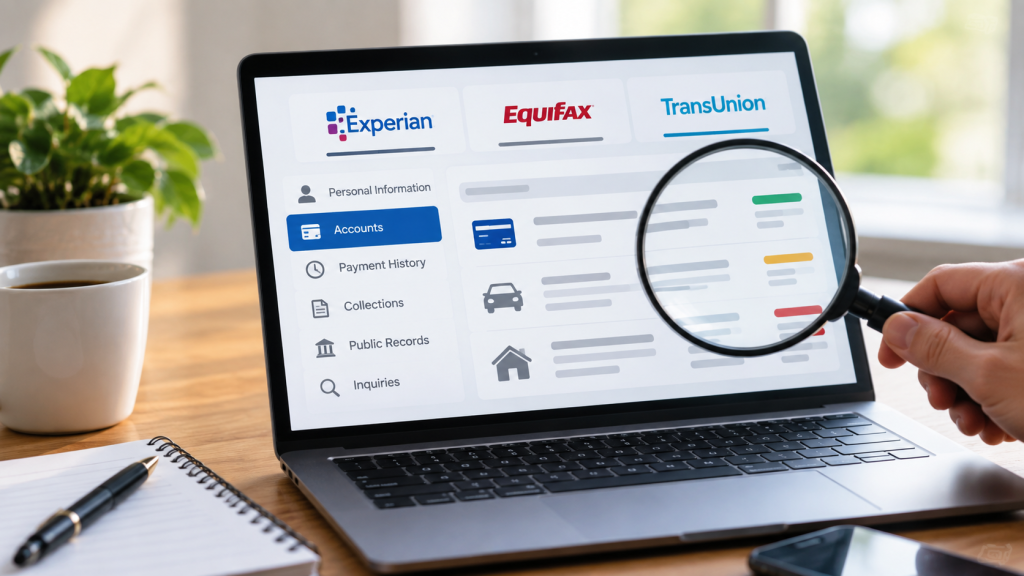
Your credit report isn’t just a score, it’s a full record of your financial behavior, broken into a few key sections that lenders review line by line. First comes your personal information, which includes your name variations, Social Security number, date of birth, and current and past addresses and employers. Next is your account history, often called tradelines, where every credit card, loan, and line of credit you’ve opened shows up along with balances, limits, and payment history. Then you have credit inquiries, which track who has checked your credit when you’ve applied for loans or credit cards. Finally, there are public records, which include serious financial events like bankruptcies or court judgments. Understanding these sections is step one, but the real confusion usually starts with the terminology used inside them, which is why knowing the key credit report terms makes such a big difference when you’re reviewing your file.
Core Credit Terms Everyone Should Know First
Most people jump straight to their credit score, but the score is just the final number. The real story lives in the details behind it, and there are a few core terms everyone should understand first.
Credit Score
Your credit score is the number everyone talks about, but most people don’t realize it’s just the result of everything happening inside your credit report. It usually ranges from 300 to 850, and lenders use it to decide whether to approve you, what interest rate you get, and how risky you look as a borrower.
The higher your score, the easier it is to qualify for loans, credit cards, apartments, and better rates. But remember, the score itself isn’t the problem or solution. It’s just the reflection of what’s inside your report.
Tradelines
A tradeline is simply any account that appears on your credit report. Every credit card, auto loan, student loan, or personal loan shows up as its own tradeline.
Each tradeline includes details like:
- Account open date
- Credit limit or loan amount
- Current balance
- Payment history
- Account status
When people talk about “cleaning up credit,” they’re usually talking about fixing issues connected to tradelines.
Payment History
This is the biggest factor affecting your credit score. Payment history shows whether you paid accounts on time or missed payments.
Late payments marked as:
- 30 days late
- 60 days late
- 90+ days late
can significantly drop your score, and multiple late payments compound the damage.
Lenders want to see consistency. Paying on time builds trust; missed payments signal risk.
Credit Utilization
Credit utilization measures how much credit you’re using compared to how much you have available.
For example, if your credit cards total $10,000 in limits and you’re carrying $5,000 in balances, you’re using 50% of your credit.
Generally:
- Under 30% utilization is good
- Under 10% is excellent
- High utilization hurts scores quickly
Even people who never miss payments can have low scores simply because their balances stay too high.
Hard Inquiries
A hard inquiry happens when you apply for credit and a lender checks your report to make a decision.
Examples include:
- Applying for credit cards
- Auto loans
- Personal loans
- Mortgages
Too many hard inquiries in a short period can slightly lower your score because it signals that you may be taking on new debt.
Soft Inquiries
A soft inquiry happens when credit is checked for informational purposes and does not impact your score.
This includes:
- Checking your own credit
- Pre-approval credit offers
- Employment or background credit checks
Soft inquiries are normal and harmless. You can check your own credit as often as you want without hurting your score.
Terms That Directly Hurt or Help Your Score

Charge-Offs
A charge-off happens when a lender gives up on collecting a debt after you’ve missed payments for an extended period, usually around 180 days.
This doesn’t mean the debt disappears. It simply means the lender moves it off their active books and often sells the debt to a collection agency.
A charge-off is one of the most damaging marks you can have on your credit report, and it can stay there for up to seven years, significantly lowering approval odds for loans and credit cards.
Collection Accounts
A collection account appears when an unpaid debt is transferred or sold to a collection agency. This often happens with credit cards, medical bills, personal loans, or utility accounts.
Collections are major red flags for lenders because they show debts went unpaid long enough to require outside recovery efforts.
Even if the original debt was small, collections can cause serious score damage and remain on your report for years unless successfully resolved or removed.
Derogatory Marks
Derogatory marks is a general term covering any negative information on your credit report.
This includes:
- Charge-offs
- Collections
- Repossessions
- Foreclosures
- Bankruptcies
- Serious delinquencies
When lenders review your file, derogatory marks are often the first things they notice. The more recent and severe they are, the harder it becomes to get approved for new credit.
Account Status
Every tradeline on your credit report shows an account status, which indicates the current condition of that account.
Common statuses include:
- Open
- Closed
- Paid as agreed
- Charged-off
- In collections
- Settled
- Delinquent
Lenders use this to quickly understand how accounts ended or whether problems are ongoing. Accounts marked negatively can continue hurting your score even after they’re closed.
Delinquencies
A delinquency means a payment was missed or paid late. Reports usually categorize them as:
- 30 days late
- 60 days late
- 90 days late
- 120+ days late
The longer the payment goes unpaid, the worse the impact. Multiple delinquencies show a pattern of financial stress and can heavily damage approval chances.
Default
A default occurs when a borrower completely fails to repay a loan according to the agreed terms. This usually happens after multiple missed payments and may lead to collections, legal action, or repossession.
Defaults are serious red flags to lenders and often make getting approved for new credit extremely difficult until time passes or the issue is resolved.
Credit Building & Score Structure Terms

Credit Age
Credit age refers to how long your credit accounts have been open. Lenders and scoring models look at both:
- The age of your oldest account
- The average age of all your accounts
The longer your accounts have been open and in good standing, the better it looks.
This is why closing old credit cards or constantly opening new accounts can sometimes hurt your score — it shortens your average credit history.
Strong credit profiles usually have accounts that have been active for years, showing stability over time.
Credit Mix
Credit mix means the variety of account types on your credit report.
Scoring models like to see that you can responsibly handle different types of debt, such as:
- Credit cards
- Auto loans
- Mortgages
- Personal loans
- Student loans
You don’t need every type of credit, but having both revolving and installment accounts shows lenders you can manage multiple payment structures.
Authorized User Accounts
An authorized user account is when someone adds you to their credit card account, allowing their account history to appear on your credit report.
If the primary account holder has:
- Long history
- Low balances
- Perfect payment record
…it can help boost your credit profile.
But if they carry high balances or miss payments, it can also hurt your score. So authorized user strategies only work when the primary account is managed responsibly.
Installment vs. Revolving Credit
There are two major types of credit accounts:
Installment Credit
These are loans with fixed payments over time, like:
- Auto loans
- Mortgages
- Student loans
- Personal loans
You borrow a set amount and pay it back in scheduled installments.
Revolving Credit
This is credit that resets as you pay it down, like:
- Credit cards
- Lines of credit
You have a credit limit and can borrow repeatedly as long as you stay within that limit.
Scoring models generally reward people who manage revolving credit responsibly while maintaining steady installment payment histories.
Legal & Dispute Terms Consumers Should Know

Debt Validation
Debt validation is your legal right to ask a debt collector to prove that a debt actually belongs to you and that the amount they’re claiming is accurate.
When a collector contacts you, you can request written validation showing:
- Who the original creditor was
- How much is owed
- Proof they have the right to collect
If they cannot properly validate the debt, they are not supposed to continue collection activity.
This step is important because debt is often sold between collectors, and mistakes happen more often than people think.
Credit Disputes
A credit dispute is the process of challenging incorrect, outdated, or unverifiable information on your credit report.
You can file disputes directly with:
- Experian
- Equifax
- TransUnion
- Or with the reporting creditor or collection agency
Once a dispute is filed, the bureau typically has 30 days to investigate.
If the item cannot be verified or is inaccurate, it must be corrected or removed.
This is the core process both individuals and credit repair companies use when cleaning up reports.
Statute of Limitations on Debt
The statute of limitations is the time period during which a creditor or collector can legally sue you to collect a debt.
This period varies by state and debt type, often ranging from 3 to 6 years, sometimes longer.
Important distinction:
- A debt can still appear on your credit report even after the statute of limitations expires.
- But once it expires, collectors may lose the right to sue you for payment.
Understanding this helps people avoid restarting old debts accidentally by making partial payments or acknowledging the debt.
Credit Reporting Time Limits (7–10 Year Rules)
Negative information does not stay on your credit report forever.
Typical reporting limits include:
- Late payments, collections, charge-offs: up to 7 years
- Chapter 13 bankruptcy: 7 years
- Chapter 7 bankruptcy: up to 10 years
After these time frames, items are required to fall off automatically.
Many people hire credit repair help when items remain longer than legally allowed or are being reported incorrectly.
FCRA Basics (Fair Credit Reporting Act)
The Fair Credit Reporting Act (FCRA) is the federal law that governs how credit information is collected and reported.
It gives consumers important protections, including:
- The right to dispute inaccurate information
- The right to know who accessed your credit report
- Limits on how long negative data can remain
- Privacy protections around your credit data
Most credit repair processes operate within rights granted under the FCRA.
How to Use This Knowledge to Actually Improve Your Score
Now that you understand what all these terms mean, the next step is turning that knowledge into action. Because knowing how credit works is great, but improving your score comes down to what you do next.
Pull All Three Credit Reports
Most people only look at one report or just watch their credit score inside a banking app. But lenders see data from all three bureaus:
- Experian
- Equifax
- TransUnion
And they don’t always show the same information.
Start by pulling reports from all three so you can compare:
- Accounts
- Dates
- Balances
- Negative items
- Personal information
Sometimes an account appears incorrectly on one bureau but not the others.
Get your free credit report
Identify Real Errors First
Not every negative item is an error. Some are simply consequences of past financial decisions.
But errors are common, including:
- Accounts that don’t belong to you
- Duplicate collections
- Incorrect late payment reporting
- Wrong balances
- Accounts not updated after settlement or payoff
- Outdated negatives still reporting
Fixing real inaccuracies should always be the first priority because those corrections often create the fastest score improvements.
Prioritize Fixes That Matter Most
Not all credit problems carry the same weight.
The biggest score impact usually comes from:
- Late payments
- Charge-offs
- Collections
- High credit card balances
- Defaults or repossessions
If your credit cards are maxed out, lowering balances may help faster than disputing small issues.
If major negatives are inaccurate, disputes should take priority.
Focus on moves that change lender risk perception, not just small cosmetic fixes.
Avoid Common Mistakes Before Applying for Big Loans
A lot of people accidentally hurt their chances right before applying for a mortgage or car loan.
Common mistakes include:
- Opening new credit cards before applying
- Financing furniture or appliances
- Taking personal loans
- Missing payments while shopping for loans
- Letting balances spike
Lenders prefer stability. Once you plan a major loan, keep everything calm and predictable.
Move From Awareness to Action
Improving credit isn’t magic. It’s a combination of:
- Correcting reporting errors
- Reducing risky signals
- Managing balances properly
- Building consistent payment history
Once you understand your report, you stop guessing — and start making decisions that actually move your score forward.
And that’s where real credit improvement begins.
How to Use This Knowledge to Improve Your Score
Understanding credit terms is one thing. Using that knowledge to actually improve your situation is what makes the difference. Here’s how to move from theory to action.
Pull all three credit reports.
Don’t rely only on your score or one credit app. Lenders may see data from Experian, Equifax, and TransUnion, and the information isn’t always identical. Reviewing all three reports helps you catch inconsistencies, duplicate accounts, or reporting errors that might only appear on one bureau.
Identify real errors first.
Not every negative item is incorrect, but many reports contain mistakes. Look for accounts that don’t belong to you, wrong balances, duplicate collections, late payments reported incorrectly, or debts that should already show as paid or removed. Correcting factual errors is often the fastest way to improve a score.
Prioritize fixes that matter most.
Some issues hurt more than others. Late payments, charge-offs, collections, and high credit card balances typically impact scores more heavily than small items. Focus first on correcting or resolving the problems that lenders see as the biggest risk signals.
Avoid common mistakes before major loan applications.
If you’re planning to apply for a mortgage, car loan, or business loan, stability matters. Avoid opening new credit accounts, financing large purchases, or letting balances spike. Even small missteps can temporarily lower scores or make lenders cautious.
The key takeaway is simple: once you understand what lenders see, you can start making decisions that actually improve approval odds, instead of guessing and hoping your score moves in the right direction.
Common Credit Report Mistakes People Miss
One of the biggest surprises for people reviewing their credit reports is how often mistakes show up, and how long they can sit there unnoticed. Many people assume everything listed must be correct, but credit reporting errors are far more common than most realize.
Duplicate collections.
Sometimes the same debt appears multiple times, especially after it’s sold from one collection agency to another. Instead of the old entry being removed, a new one gets added, making it look like you have multiple debts when it’s really just one account being reported twice.
Old debts being re-aged.
Some accounts show a newer activity date than they should, making the debt appear more recent. This can unfairly extend how long negative information impacts your credit. Debts are supposed to age off your report based on the original delinquency date, not when they’re sold or reassigned.
Incorrect balances or payment status.
It’s not unusual to see accounts listed as still owed even after being paid or settled. Other times, balances are wrong or payment history shows late payments that never actually happened. These errors can significantly drag down a score if left unchecked.
Mixed credit files.
This happens when information belonging to someone with a similar name or Social Security number ends up on your report. Suddenly, accounts you never opened show up, or inquiries appear from places you’ve never done business with. This mistake can seriously hurt approval chances if not corrected.
The reality is, many people carry credit report errors for years simply because they never look closely enough. Catching and correcting these mistakes can sometimes produce faster results than trying to build credit from scratch.
Credit Knowledge Equals Financial Leverage
At the end of the day, understanding your credit report isn’t just about a number, it’s about leverage. Better credit knowledge leads to better loan approvals, better interest rates, and better financial opportunities overall. And those better rates? They can save you tens of thousands of dollars over the life of a mortgage, car loan, or business financing.
What most people don’t realize is that small fixes often create massive financial wins. Correcting a few reporting errors, lowering utilization, or cleaning up a handful of negative items can completely change what lenders are willing to offer you.
If you’re looking at your credit report and feel overwhelmed, or you’re not sure where to start, you don’t have to figure it out alone.
👉 Reach out through our Contact Us page and let our team help you review your situation and map out the best next steps.
Sometimes the difference between staying stuck and moving forward is just having the right guidance at the right time.
Author Profile

- Michael Harrington is a senior credit analyst and contributor at Credit Repair Dudes, specializing in consumer credit reporting, dispute methodology, and long-term credit profile improvement. With extensive experience analyzing bureau data, lender behavior, and FCRA compliance, Michael focuses on helping consumers understand how credit decisions are actually made, and how to protect and improve their credit responsibly. His work emphasizes accuracy, transparency, and practical strategy over shortcuts or gimmicks.
Latest entries
 Credit EducationFebruary 20, 2026Legal Harbor Review (2026) — Is It Legit or Worth It?
 Credit EducationFebruary 8, 202620 Credit Report Terms Everyone Should Know Before Applying for a Loan
 Credit EducationFebruary 3, 2026What to Do When a Collection Agency Calls You, Step by Step Guide
 Credit EducationJanuary 26, 2026Sky Blue Credit Repair Reviews — In-Depth, Neutral Analysis